Most people who ask about a dental implant have lived with the problem for a while. A back tooth was pulled years ago and the gap never got filled. A crown cracked and the tooth under it could not be saved. Or a bridge has failed and they are not sure they want another one.
The short answer is that an implant is the closest thing dentistry has to a new tooth. It replaces the root as well as the crown, it sits in your jawbone, and it does not lean on the teeth next to it.
The longer answer is that an implant is a process measured in months, not a single appointment. The health of your gums and bone, how long the tooth has been missing, and how you care for it afterward all shape the result. Knowing how it works up front makes it much easier to judge any plan you hear.
This guide covers how implants work, who is a good fit, how planning and surgery happen, when bone grafting is needed, how implants compare with bridges and dentures, the questions worth asking, and what cost and insurance usually look like. Crystal Ladhar D.D.S. is a single-doctor practice on Saratoga Avenue in west San Jose, and every implant here is planned and placed by Dr. Crystal Ladhar.
How a Dental Implant Works
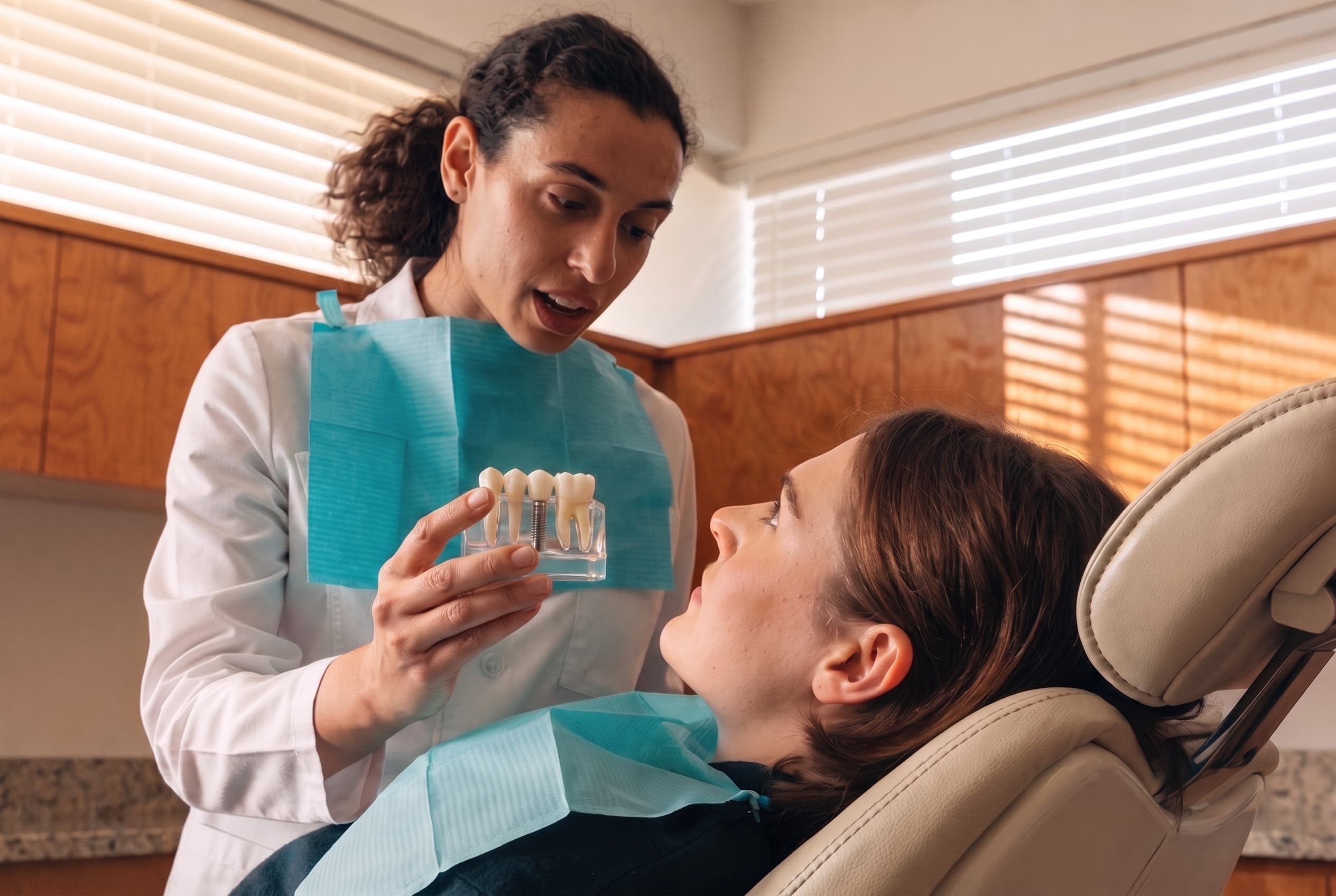
A dental implant has three parts. A small titanium post goes into the jawbone where the root used to be. A connector piece, called an abutment, attaches to the top of the post. A crown that looks like a natural tooth goes on last.
The key step happens after the post is placed. Over three to six months, your jawbone grows tightly around it. That bond is what makes an implant strong enough to chew on like a natural tooth, and the crown only goes on once that foundation is solid.
Because an implant sits in bone, it also does something no other replacement does. Jawbone that no longer holds a tooth slowly shrinks. An implant gives that bone a job again, which helps slow the loss.
Who Is a Good Candidate
Most adults who are missing a tooth, or have a tooth that cannot be saved, can be considered for an implant. A few things need to be true first:
- Your gums are healthy, or gum disease has been treated and is under control
- There is enough bone to hold the post, or you are open to bone grafting
- Your overall health allows for minor oral surgery
- You are ready to keep the implant clean and come in for regular visits
Some things make implants harder but not impossible. Smoking and uncontrolled diabetes both raise the chance that an implant fails to bond with the bone. Heavy grinding at night puts extra stress on the crown. Certain medications, including bisphosphonates for bone density, also need to be reviewed. None of these rule you out on their own, but each one belongs in the conversation.
Gum health matters most. Our post on why your gums matter to the rest of your body explains why gum disease has to be under control before an implant goes in.
How Implant Planning and Surgery Work
Planning on a 3D scan
Every implant starts with 3D imaging. The scan shows the height and width of your bone and the exact location of nerves and the sinus. Dr. Ladhar plans the implant's position on screen before any surgery happens.
Guided implant surgery
For most patients, that digital plan becomes a surgical guide. With guided implant surgery, a guide made from your scan fits over your teeth and directs the position, angle, and depth of the implant. The hard decisions get made ahead of time on a screen instead of in your mouth. That usually means a smaller opening, less bleeding, and an easier recovery.
The day of placement
Placement is done with local anesthetic and usually takes about an hour. If you are nervous, laughing gas or oral sedation is available. Most people say it felt easier than a hard extraction, which tends to surprise them.
Healing and the final crown
After placement, the bone needs three to six months to bond with the post. Expect a few days of swelling and soreness, managed with ibuprofen and soft food. The long wait after that is not painful. Once the implant is stable, your crown is made and attached.
When Bone Grafting Is Needed
Jawbone starts to shrink once a tooth is gone, and much of that loss can happen in the first year. If a tooth has been missing for a while, there may not be enough bone left to hold an implant safely.
Bone grafting rebuilds that area. Graft material is placed where the bone has thinned, and your body slowly replaces it with its own bone. Healing takes four to nine months before an implant can go in, depending on how much bone had to be built.
If you are having a tooth removed now, ask about a socket bone graft. Graft material goes into the socket during the same visit, which adds about ten to twenty minutes. It saves bone while it is still there and often avoids a larger graft later, even if the implant is years away.
Implants, Bridges, and Dentures: How They Compare
An implant is not the only way to replace a tooth. The right choice depends on your bone, the teeth around the gap, your budget, and how long you want the result to last.
Dental implant
An implant replaces the root and the crown. It does not involve the teeth on either side, and it helps slow bone loss. It takes the longest and usually costs the most up front.
Dental bridge
A bridge uses crowns on the teeth on either side of the gap to hold a replacement tooth. It is usually done in two to three weeks. The trade-off is that two teeth must be shaped to replace one. A bridge can make sense when those neighboring teeth already need crowns.
Dentures
Dentures are removable and can replace several teeth or a full arch. They are often the most affordable option, and they can be a reasonable step while saving for implants. They take practice to wear and need relining over the years as the bone underneath changes.
Dr. Ladhar lays out every option that fits your mouth, including the cost difference, before you choose.
Ten Questions to Ask Before Getting a Dental Implant
Ask these at any practice you are considering. The answers show how the office plans as much as what it recommends.
- Who plans my implant, and who places it? Ask whether the same dentist handles the scan, the surgery, and the crown.
- Will my implant be planned on a 3D scan? You should see your bone, nerves, and sinus on screen before surgery.
- Will you use a surgical guide? Guided placement turns the plan into a precise step instead of a judgment call in the chair.
- Do I have enough bone, or will I need a graft? The answer should come from your scan, not a guess.
- Are my gums healthy enough to start? Active gum disease needs to be treated first.
- What is the full timeline, from today to the final crown? A written range helps you plan around work and travel.
- What will fill the gap while the implant heals? Ask about temporary options, especially for a front tooth.
- How do my health and habits affect success? Smoking, diabetes, grinding, and some medications all matter.
- What does the full fee include? Ask for the scan, surgery, any graft, the abutment, and the crown priced together.
- How do I care for it long term? An implant cannot get a cavity, but the gum around it can still become infected.
What Dental Implants Cost
The cost of an implant depends on how many teeth are being replaced, whether you need a bone graft, and the type of crown. Any number quoted before a scan is a guess. At our office, Anna, our treatment coordinator, prices the whole sequence in writing before you commit to any of it. That usually includes:
- 3D imaging and treatment planning
- The surgical guide, when one is used
- Implant placement
- Any bone grafting your case needs
- The abutment and final crown
Guided placement includes lab and planning costs, so it is priced above freehand placement. Anna can show you that difference in writing.
There are several ways to spread out the cost. Established patients can arrange in-house payments with Anna, third-party financing is available to any patient at no extra cost, and patients 65 and over take five percent off treatment. If you have no insurance, ask about our in-office membership plan.
Does Dental Insurance Cover Implants?
Dental insurance rarely covers implants well. Some plans pay part of the cost, some pay only toward the crown, and some pay what they would for a bridge. Annual maximums are often low compared with the cost of an implant, so a plan may cover only a small share.
We are out of network with every insurer, and we accept all PPO plans. Linda, our billing coordinator, files your claim and follows up when it stalls, so you are not the one on hold. Before treatment starts, send us your plan details through our benefits check and Linda will tell you what to expect. We do not accept HMO plans or medical insurance. Our post on why we are out of network explains what that means for your bill.
Red Flags When Comparing Implant Offices
Most dental offices in San Jose do good work. These patterns deserve a second look:
- An implant quoted without a 3D scan
- No check of gum health before surgery
- A low starting price that leaves out the graft, abutment, or crown
- No mention of how smoking, diabetes, or grinding affect the result
- Only one option offered, with no comparison to a bridge or denture
- No plan for checkups after the crown goes on
How Our Office Approaches Implants
Dr. Ladhar keeps the practice general on purpose, with real depth in implants. She is a member of the American Academy of Implant Dentistry, and every implant is planned on 3D imaging before surgery. Your hygienists already know your gums, which matters because healthy gum tissue is what keeps an implant healthy for years.
Treatment planning here starts with education, not sales. You see your scan, hear every option that fits, and get a written, priced plan in the order that makes sense. Nothing is scheduled that you have not agreed to.
None of this replaces an in-person exam. Timelines, options, and fees are set only after your teeth, gums, and bone have been examined.
Book an Implant Consultation in San Jose
If you are missing a tooth, or have been told a tooth cannot be saved, a consultation is the simplest next step. You leave knowing whether an implant fits, whether you need a graft, how long it will take, and what it will cost.
Crystal Ladhar D.D.S. is at 991 Saratoga Ave, Ste 210, in west San Jose, open Monday through Thursday from 7:30 am to 5:00 pm. Call (408) 252-5575 or request a visit online, and we will walk you through your options.